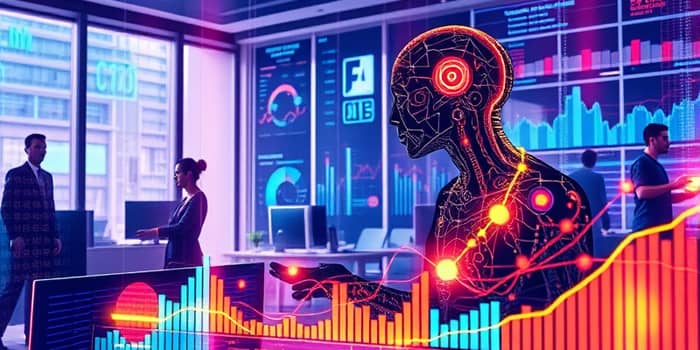
In an era of relentless data growth and rapid technological change, finance professionals face the challenge of making timely decisions without sacrificing depth or oversight. Augmented intelligence emerges as a bridge between raw computing power and human judgment, offering a collaborative model that elevates both machines and people. This approach enables firms to harness insights at unprecedented speed while preserving the ethical and contextual oversight only humans can provide.
Unlike the narrative of full automation, augmented intelligence focuses on enhancing human decision-making capabilities by pairing advanced algorithms with human expertise. AI handles vast datasets, complex pattern recognition, and rapid predictions, while professionals retain final approval, ethical guidance, and creative problem-solving. This partnership ensures that every decision is both data-driven and contextually sound.
By prioritizing collaboration over replacement, companies avoid the pitfalls of blind automation. Augmented intelligence fosters continuous learning cycles: AI refines its models based on human feedback, and experts gain deeper insights through AI-generated analytics.
Financial analysis and forecasting benefit immensely from this synergy. AI systems can sift through millions of transactions, market feeds, and economic indicators within seconds. Humans then interpret the anomalies, validate predictions, and craft strategic responses.
For example, predictive forecasting models ingest historical performance and live market signals, offering probability curves for various outcomes. Analysts refine these outputs by applying industry knowledge, ensuring plans remain agile and realistic.
Fraud prevention and compliance illustrate another powerful use case. AI continuously monitors transactions, flagging irregularities based on behavioral baselines. Rather than outright blocking, flagged cases move to a human team for review, maintaining customer trust and reducing false positives.
Advanced systems generate context-aware risk assessments at scale by cross-referencing user histories, external news feeds, and network graphs. Professionals then adjudicate cases with a nuanced understanding of intent and impact, ensuring regulatory compliance and operational integrity.
Delivering tailored financial products at scale requires deep understanding of individual client preferences. Augmented intelligence platforms analyze transaction behaviors, call center transcripts, and social signals to build a 360-degree view of each customer. Robo-advisors can propose initial investment allocations, while human advisors step in when complex scenarios arise or trust-building is essential.
This collaborative model boosts engagement: clients receive rapid, data-informed recommendations without losing the personal connection that fosters long-term loyalty.
Routine processes such as month-end closing, compliance documentation, and report generation are prime candidates for automation. AI-powered tools draft summaries, reconcile accounts, and flag anomalies. Humans focus on exception handling, strategic planning, and policy refinement.
By delegating repetitive tasks, teams gain time for high-value work, driving innovation and continuous improvement across departments.
Adopting augmented intelligence in finance drives measurable value:
However, challenges remain. Data quality, model transparency, and ethical governance demand ongoing attention. Organizations must invest in training, establish clear protocols for human-AI handoffs, and foster a culture of collaboration.
To implement augmented intelligence effectively, finance leaders can follow these steps:
Augmented intelligence represents a transformative path for the finance industry, blending the precision of machines with the wisdom of human experts. By embracing this collaborative model, institutions unlock new levels of efficiency, trust, and innovation. The future of finance lies not in machines replacing humans, but in their partnership—enabling smarter decisions, deeper insights, and greater value for all stakeholders.
References