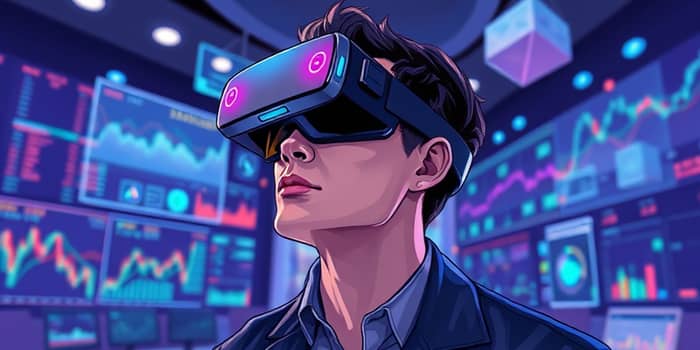
Imagine stepping into a trading environment where market data springs to life around you. Augmented trading platforms are transforming the way traders interpret complex information, merging the digital and physical worlds into a seamless decision-making arena.
As global markets grow more intricate, these systems deliver truly immersive data visualization that elevates analysis beyond flat screens and spreadsheets.
At the heart of augmented trading platforms lie specialized hardware and software solutions designed for intuitive interaction. From headsets that overlay data onto your real-world view to gloves that sense micro-gestures, this ecosystem empowers traders with unprecedented control.
Leading devices include the Magic Leap 3 Professional Edition, which offers adaptive lens opacity and quantum-grade security, and wearable gear like the Tactile Trading Suit featuring a full-body haptic feedback system that alerts traders to subtle market shifts.
Quantified results show that augmented platforms deliver measurable improvements across asset classes. In forex, traders achieved a 53% faster opportunity identification and a 38% improvement in trade timing, generating an extra $4.2 million in annual P&L.
Fixed income teams experienced a 40% acceleration in yield curve analysis and 92% trade accuracy, uncovering three new arbitrage strategies. Retail platforms saw session durations soar from 15 to 47 minutes, with 27% better timing and 83% deeper market insight.
Major financial institutions like Goldman Sachs, BlackRock, and Citadel have integrated AR for yield curve visualization, risk modeling, and liquidity tracking. These pioneers leverage immersive scenarios to collaborate in shared virtual workspaces without losing contextual awareness.
On the retail side, platforms such as TradingView AR and eToro’s social AR are democratizing advanced analytics, allowing individual traders to explore spatial organization mirroring natural cognitive processes and trade alongside peers in real time.
Augmented trading platforms do more than display data: they harness machine learning to interpret patterns and suggest strategies. By combining gesture controls with AI-driven what-if scenario projections, traders can simulate outcomes and optimize risk-reward tradeoffs in seconds.
Cloud-based deployment ensures seamless updates and cost-effective scaling, while algorithmic engines continuously ingest alternative data—sentiment signals, geospatial feeds, and behavioral metrics—to refine real-time predictions.
Effective risk management is paramount in volatile markets. AR systems embed risk engines capable of real-time risk simulation holograms that visualize exposure across portfolios, dynamically adjusting parameters to evolving conditions.
Scenarios such as sudden liquidity shocks or correlated asset downturns can be tested instantly, enabling traders to deploy hedging strategies with confidence and compliance frameworks pre-built for audit trails.
The next frontier includes quantum-enhanced AR platforms featuring instantaneous processing of global market data streams. These systems promise entangled asset correlation views and superposition-based probability displays, securing trade execution with unbreakable encryption.
Other trends include multi-asset integration—unifying equities, commodities, derivatives, currencies, and digital assets in a single interface—and the growth of high-frequency algorithmic trading, which now represents over 60% of retail trades in developed markets.
The augmented reality market is set to skyrocket from $120.21 billion in 2025 to $1,050.56 billion by 2033 at a 29.7% CAGR. AI trading platforms will grow from $220.5 million in 2025 to $631.9 million by 2035, driven by rapid adoption in North America, China, and Australia.
Algorithmic trading alone will expand from $2.53 billion in 2025 to $4.33 billion by 2034, with cloud-based solutions leading the charge. This robust expansion underscores the transformative impact of AR on financial decision-making.
Despite these advances, barriers remain. Ensuring user-friendly interfaces, overcoming regulatory hurdles, and safeguarding data privacy demand continuous innovation. Training programs and digital literacy initiatives are critical to onboarding new users effectively.
Yet the opportunities are immense. By converging AR, AI, and cloud computing, traders can unlock deeper insights, execute with greater precision, and collaborate across borders. The future of trading is not just digital—it’s augmented, adaptive, and profoundly human.
References