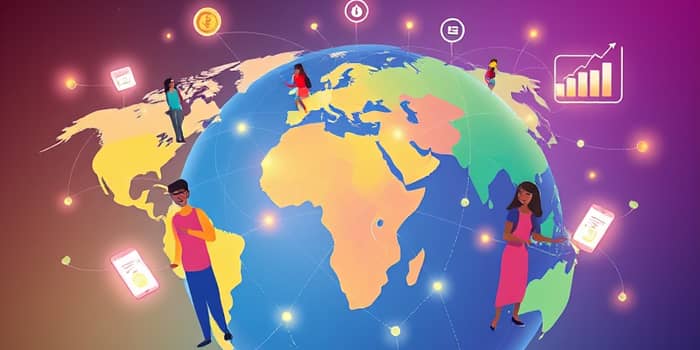
In a world where economic opportunities are often limited by geography and income, financial inclusion stands as a beacon of hope. The journey from exclusion to empowerment is not just a policy goal but a profound human story.
It is about ensuring that everyone, from rural farmers to urban entrepreneurs, can access the tools to build a secure and prosperous future. This vision drives global efforts to bridge financial divides.
As we enter a new era, technology and policy are converging to break down barriers in unprecedented ways. The progress is inspiring, but the challenges remind us of the work ahead.
Traditionally, financial inclusion was measured by simple account ownership. Today, it encompasses a broader, more impactful definition.
The World Bank defines it as access to useful and affordable financial products and services. However, the focus has shifted dramatically.
From access to meaningful outcomes is the new paradigm. This means prioritizing financial health, resilience, and economic participation over mere metrics.
To understand this evolution, consider the contrasting approaches that shape the field.
This shift reflects a deeper commitment to holistic empowerment. It acknowledges that true inclusion goes beyond numbers.
According to the Global Findex, account ownership has surged from 51% in 2011 to around 80% in 2025. This remarkable growth highlights decades of concerted effort.
Mobile phones have been a critical enabler, with 86% of adults globally owning one. This connectivity fuels digital financial services, especially in developing regions.
Despite these gains, approximately 1.4 billion adults remain unbanked. They lack access to formal financial resources, hindering their economic potential.
Key data points illustrate both progress and gaps.
However, access does not guarantee meaningful usage. In low- and middle-income economies, significant issues persist.
The gap between access and usage underscores a second-generation challenge. It calls for innovative solutions.
The Global Financial Inclusion Index analyzes 42 markets based on government, financial system, and employer support. It provides a comprehensive view of regional performances.
Scores have improved from 41.7 in 2022 to 49.6 in 2024, with a slight decline in 2025 due to macroeconomic pressures. Overall progress remains strong above the 2022 baseline.
Leading markets demonstrate what is possible with robust support structures.
Conversely, lagging markets face significant hurdles. Italy has the lowest score in Europe at 34.9, while Turkey is at 39.3.
A breakdown by pillars reveals nuanced strengths and weaknesses.
Regional disparities highlight the need for tailored strategies. The G20 recognizes financial inclusion as key in fighting poverty, with data dashboards for global comparison.
The period 2025-2026 marks an inflection point for financial inclusion. With near-universal account access, the focus is turning to enabling conditions and outcomes.
Findex 2025 starts with mobile ownership, signaling that technology access is now integral. This shift prioritizes connectivity and digital literacy.
Future efforts will intersect with broader development agendas.
Outcomes like economic participation are becoming central goals. This means measuring success by improved livelihoods, not just account numbers.
Funding landscapes are also transforming. Key developments in 2025 signal a reordering.
This shift emphasizes domestic resources, private capital, and blended finance. Blended finance models are gaining traction for sustainable impact.
Digital technologies have accelerated financial inclusion exponentially. Mobile money and fintech innovations bridge gaps in underserved regions, especially in Africa and Asia.
During the COVID-19 pandemic, digital payments were a lifeline. They enabled governments to channel transfers and supported small businesses unable to transact in cash.
Fintech and purposeful digitization are driving progress in fast-moving markets. Key elements include:
Cross-border digital ecosystems are expanding, making global inclusion more feasible. These infrastructures enable cheaper, faster payments and new business models.
For example, pay-as-you-go services and micro-savings apps are transforming how people manage money. This technological leap is empowering millions.
True financial inclusion goes beyond payments to encompass savings, credit, insurance, and pensions. These services build resilience and enable long-term planning.
For individuals, practical steps can enhance financial health.
For policymakers and organizations, fostering an enabling environment is crucial. This involves regulatory support for fintech and investments in digital infrastructure.
Financial health as a cornerstone of development is now widely recognized. It empowers people to weather economic storms and pursue opportunities.
As we look ahead, collaboration across sectors will be key. Governments, private firms, communities, and international bodies must work together.
The journey towards global financial inclusion is ongoing, but with innovation and commitment, we can create a more equitable world. Let this inspire action in every corner of the globe.
References