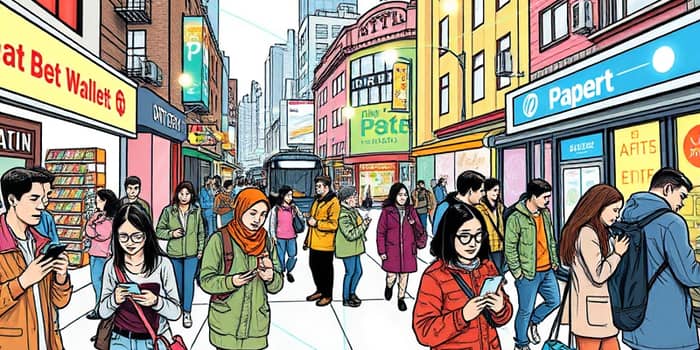
The movement toward a cashless world is not simply a matter of convenience; it represents a profound transformation in how societies exchange value, interact with institutions, and envision economic growth. From bustling urban centers in China to Scandinavian nations pioneering digital wallets, the shift away from physical currency is underway, carrying both promises and challenges.
Over the past decade, rapid adoption of mobile payments has reshaped retail landscapes and everyday transactions. According to recent studies, a majority of in-person purchases are now handled digitally, reflecting a collective embrace of new payment technologies.
Regional leaders illustrate the range of progress. In China, 91% of urban purchases are digital, while Sweden reports over 90% cashless point-of-sale transactions. Even in traditionally cash-focused economies like Brazil and India, instant payment systems and unified payment interfaces are driving over 70% digital usage.
Economists project that a full embrace of cashless systems could add up to 3 percentage points to annual GDP growth in mature economies and even more in emerging markets. This boost stems largely from reduced handling costs, improved transparency, and streamlined tax compliance and oversight.
Beyond macroeconomic gains, businesses reap tangible rewards. Retailers report a 50% reduction in cash-handling costs, faster checkout lines, and fewer incidents of theft or fraud. Financial institutions benefit from enhanced transaction monitoring and reporting, enabling more efficient lending and risk management.
Trends vary by demographic group. Gen Z overwhelmingly favors digital over physical currency, while older consumers are gradually increasing their cashless transactions. Income also influences adoption: high earners exceed 80% digital usage, while lower-income groups retain stronger ties to cash.
Despite enthusiasm, nearly half of consumers express privacy concerns and 84% oppose a fully cashless society, underscoring the need for balanced policy approaches that protect individual choice.
For merchants, the transition brings greater operational efficiency and reduced overhead. Accounting becomes more accurate and real-time, leading to streamlined tax filings and financial statements. Mobile money platforms also unlock new revenue streams through value-added services, loyalty integrations, and microfinancing applications.
Financial service providers leverage AI-driven fraud detection, cutting fraudulent transactions by nearly half in recent years. Blockchain-based settlement systems further promise immutable records and trustless exchanges, paving the way for cross-border trade at lower cost.
Beyond economic metrics, digital payments foster enhanced financial inclusion for many. Unbanked populations gain access to remittances, savings, and credit options through mobile wallets, while governments can better allocate resources based on transparent revenue flows.
Crime rates linked to physical cash drop, and communities benefit from safer streets. Consumers also enjoy better financial tracking, which helps instill budgeting discipline and detect irregularities quickly.
Not all implications are positive. A fully cashless system can deepen digital divides and financial exclusion if vulnerable groups lack access to smartphones, reliable internet, or basic digital literacy.
Governments and regulators must ensure robust digital infrastructure, data protection laws, and fallback mechanisms to maintain trust and system resilience.
Sweden’s near-elimination of cash highlights how public-private collaboration and widespread trust can drive transformation. In China, super-apps like WeChat Pay integrate payments into daily life, from grocery shopping to utility bills. India’s UPI has become a global model for interoperable instant payments, lifting millions into formal financial systems.
Meanwhile, rural areas in the United States lag behind urban centers, revealing that infrastructure gaps still hinder universal adoption, and targeted investment is essential.
Experts predict a coexistence of cash and digital methods for the foreseeable future. While digital payments grow more sophisticated—incorporating IoT, wearables, and biometric authentication—cash remains a vital option for emergency preparedness and personal choice.
Key to sustainable progress is a balanced approach: investing in inclusive digital literacy, strengthening consumer protections, and fostering innovation without leaving communities behind.
The global tilt toward cashless societies offers vibrant exchange of value digitally and the promise of greater efficiency, inclusion, and security. Yet it also demands careful management of privacy, accessibility, and infrastructure challenges.
By addressing these issues through thoughtful regulation, public-private partnerships, and inclusive education, policymakers can harness the full potential of a cashless future, ensuring it benefits all members of society rather than creating new divides.
References