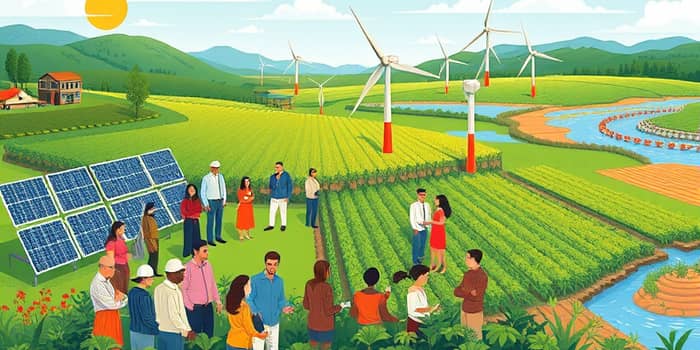
As communities around the world grapple with extreme weather, sea level rise, and shifting agricultural patterns, the call for robust funding to tackle climate challenges has never been clearer. Climate finance is the engine that drives transition to low-carbon economies, builds defenses against disasters, and empowers vulnerable populations. By channeling capital into innovative solutions, we can forge a path to a future defined by stability, equity, and prosperity.
The term climate finance encompasses the mobilization of resources dedicated to limiting global temperature rise and strengthening resilience. According to the UNFCCC, it is
financial resources from public and private capital mobilization aimed at reducing emissions, expanding greenhouse gas sinks, and enhancing the resilience of human and ecological systems.
These resources flow through bilateral channels, multilateral institutions, private investment vehicles, and a growing array of innovative mechanisms designed to align profit with purpose.
Climate finance splits into two core pillars: mitigation, which seeks to curb greenhouse gas emissions, and adaptation, which aims at
building long-term climate resilience in communities and ecosystems. While mitigation accounts for over 90% of current spending, adaptation is rapidly emerging as a critical frontier.
Key instruments powering these efforts include:
Global investment in clean energy and low-emission technologies reached approximately $2 trillion annually in recent years, with the energy transition attracting $2.3 trillion in 2025—an 8% uptick over 2024. In parallel, adaptation finance is poised to become a $9 trillion opportunity by mid-century, yet a
significant funding gap remains unaddressed in developing countries, where vulnerability is highest. COP29 set a goal of mobilizing $1.3 trillion annually for adaptation and resilience by 2030, while multilateral development banks are expanding balance sheets to deploy more concessional capital.
Despite impressive flows, aligned and standardized financing structures remain vital to channel capital efficiently across regions and sectors.
As investors sharpen their focus, several trends define the climate finance landscape this year. Emphasis is shifting beyond wind and solar to encompass grid infrastructure, industrial decarbonization, and carbon removal technologies. Governments have pledged to triple public adaptation finance by 2035, while private investors are recognizing
adaptation finance as a growth market rather than merely a hedge against losses. Furthermore, blended finance solutions are pairing public guarantees with private equity to unlock projects in underserved regions.
For philanthropy, institutional investors, and development banks, the moment to act is now. By adopting rigorous climate risk assessments, fund managers can direct resources where they yield the greatest societal and financial returns. Research shows firms engaged on climate targets deliver up to 12% higher peer-adjusted returns over two years.
It is crucial to
mobilize private capital at scale through blended structures, standardized instruments, and harmonized taxonomies that reduce due diligence costs and enhance creditworthiness in emerging markets.
The urgency of the climate crisis demands bold ambition and collaborative effort. By leveraging blended finance, scaling up adaptation investments, and bridging the funding gap, we can create an equitable green transition. Each dollar invested today lays the groundwork for cleaner skies, secure food systems, and thriving communities.
Let us unite to
harness diverse financing tools and strategies that transform risk into opportunity. Together, we can ensure a resilient future for generations to come.
References