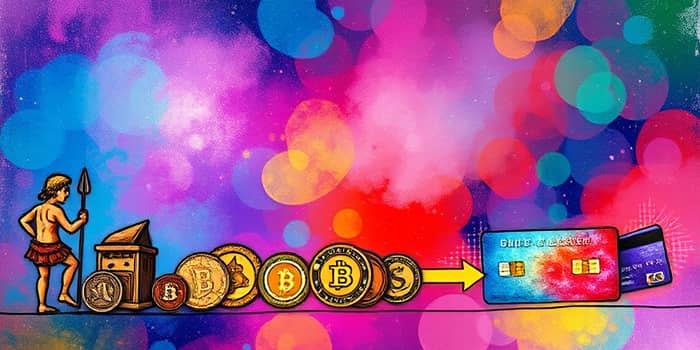
From the earliest exchange of goods to the cutting-edge applications of distributed ledgers, the concept of credit has continually transformed the way we conduct transactions. This journey reflects humanity’s quest for convenience, security, and trust in commerce.
In this comprehensive exploration, we chart the remarkable shifts in credit systems, revealing how each innovation built upon the last to shape the modern financial landscape.
Long before coinage or paper money, ancient societies practiced barter, trading surplus goods for essential items. These exchanges often relied on informal agreements and reputations, laying the groundwork for delayed payment mechanisms that transcended direct swaps. Archaeological evidence suggests that by the 18th century BC, Mesopotamian traders recorded promissory obligations on clay tablets.
In 1865, merchants introduced the first charge coins—metal or celluloid tokens stamped with retailer details and account numbers. These tokens, popular among farming communities, allowed customers to settle balances after seasonal harvests. As urban centers expanded, shopkeepers extended credit directly to patrons, creating a patchwork of localized store-based accounts that would endure well into the 20th century.
The Progressive Era ushered in new forms of organized credit. In the 1920s, Roy F. Bergengren spearheaded the growth of credit unions, forming the Credit Union National Extension Bureau. By 1935, laws in 38 states recognized cooperative credit societies, marking a shift toward people-focused lending models.
Aviation’s golden age saw another innovation. The Air Travel Card launched in 1934, enabling passengers to book flights immediately and pay later. Within a decade, 17 major airlines adopted similar programs, demonstrating how industry collaboration could standardize credit across vast networks.
In 1946, Brooklyn’s Citizens Bank introduced the Charg-It card, a direct precursor to modern bank cards. Customers charged purchases at participating merchants, and the bank settled the bill later, receiving transaction fees. This move by a single bank laid the foundation for widespread adoption by financial institutions.
1950 marked a watershed moment with the launch of the Diners Club card. As the first card to serve multiple merchants nationwide, it initially targeted travel and entertainment expenses. Although balances had to be paid in full each month, its rapid success prompted Franklin National Bank to issue the first bank-branded card in 1951.
Revolving credit arrived in 1958 when Bank of America mailed 60,000 unsolicited BankAmericard offers in California. For the first time, cardholders could carry unpaid balances month to month, incurring interest. American Express followed suit, issuing its own embossed plastic card later that year. Innovations like magnetic stripes, introduced by IBM in 1969, further enhanced fraud protection and transaction speed.
By the late 1960s, the volume of credit activity demanded centralized data collection. Three major bureaus emerged to fill this role, consolidating information on millions of consumers:
The Fair Credit Reporting Act of 1970 introduced critical consumer protections, mandating disclosure of credit information sources and the removal of discriminatory factors such as race or religion. These regulations laid the legal groundwork for trust in credit markets.
In 1989, Fair Isaac and Company launched the first FICO Score. By quantifying payment history, debt levels, and credit age, the standardized scoring system replaced subjective evaluations, enabling lenders to make consistent, data-driven decisions. Electronic processing systems throughout the 1980s further accelerated the pace of approval and settlement across credit networks.
The 1990s brought heightened security concerns as magnetic stripe fraud rose. Europay, Mastercard, and Visa collaborated to develop EMV chip technology in 1994, embedding microprocessors into cards to authenticate transactions. This leap significantly reduced counterfeit risk and paved the way for global standardization.
Contactless payments debuted in Korea in 1995, setting the stage for tap-to-pay convenience. Meanwhile, the formation of the Interbank Card Association solidified Mastercard’s international reach. By the early 2000s, digital processing hubs enabled real-time authorization, dramatically shrinking the latency of cross-border transactions.
The smartphone era arrived in 2008 with Apple’s App Store, catalyzing mobile wallets and apps that stored card data securely on devices. Consumers began tapping phones for public transit fares and retail purchases, blurring the lines between plastic and digital tokens.
Enter blockchain: a shared, immutable ledger for transactions that democratizes access to credit. By eliminating intermediaries, blockchain networks can settle payments instantly, reduce costs, and prevent chargeback fraud through cryptographic consensus.
Fintech innovators leverage smart contracts to automate loan agreements. Borrowers can receive funds the moment predefined conditions are met, while repayment schedules execute automatically, minimizing human error and bias. Platforms now aggregate on-chain activity, open banking records, and alternative data—such as utility payments—to calculate creditworthiness for underbanked populations.
Decentralized identity solutions add another layer of protection. Consumers control their personal information, granting selective access to lenders while safeguarding against centralized data breaches. This model shifts power back to individuals, enhancing privacy and trust.
Cross-border settlements are a standout use case. Stablecoins like USDC enable companies to move value across borders at minimal cost, converting on-chain balances to local currency through partners like BVNK. Services such as Veem blend traditional banking rails with blockchain, offering hybrid solutions that ease regulatory compliance.
Despite challenges—such as interoperability and evolving regulations—blockchain’s promise lies in secure peer-to-peer settlements and broader financial inclusion. As standards mature, these systems could underlie the next generation of credit, removing legacy constraints and unlocking global liquidity.
From clay tablets to digital ledgers, credit has evolved in response to societal demands for convenience, trust, and equity. Each milestone represents a leap toward more inclusive and efficient financial systems.
As we stand at the threshold of a decentralized future, understanding this rich tapestry of innovation empowers both individuals and institutions to harness emergent technologies with confidence. The next era of credit promises to blur the boundaries between technology and human ingenuity, unlocking possibilities we have yet to imagine.
References