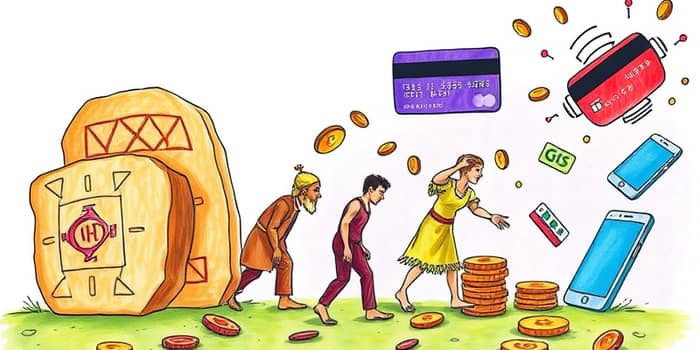
Over thousands of years, humanity has continually innovated the ways we exchange value. From simple barter to complex digital networks, the journey of payments and credit reveals how technology and trust intertwine. As we stand in 2026, new forces are redefining this landscape, promising unprecedented convenience and security.
Credit concepts trace back to ancient Mesopotamia, where merchants recorded debts on clay tablets. By the late 19th century, farmers and travelers relied on metal tokens to defer payments, foreshadowing the rise of plastic alternatives. The early 1900s introduced money orders and travelers’ checks, setting the stage for modern charge accounts.
These milestones marked a pivotal shift: from fragmented credit instruments to pioneering universal charge card system, enabling consumers to carry a single credential worldwide.
The 1970s ushered in debit cards and magnetic stripe technology, courtesy of IBM’s partnership with American Express. By the late 1980s, electronic payment processing networks had transformed retail checkouts, while early online banking emerged in the UK and the U.S.
In the 1990s and 2000s, advances like RFID, EMV chip cards, and contactless payments began to replace physical swipes and signatures. The 2008 financial crisis accelerated digital adoption, fueling mobile wallets and internet commerce. By 2012, chip cards and tokenization became standard, setting the foundation for today’s frictionless transactions.
Global payment volumes surpassed $36 trillion, driven by platforms and super apps embedding financial services. 2026 marks the first year where half of world consumer payments use card credentials, even for micro-transactions like a $1 bus fare or a $2 coffee.
E-commerce guest checkout abandonment fell from roughly 50% in 2019 to 16% in 2025, thanks to one-click buy buttons and over 16 billion Visa tokens in circulation. Consumers now enjoy near-instant purchases with minimal friction, while merchants benefit from higher conversion rates and reduced fraud.
Several interlocking trends are poised to redefine credit and payments throughout 2026 and beyond.
Agentic commerce, enabled by powerful AI, allows virtual assistants to shop, compare prices, and complete transactions on users’ behalf. In parallel, stablecoins and tokenized deposits are gaining traction in emerging markets, providing a secure store of value alternative and streamlining cross-border settlements.
Interoperability and real-time payments are now mainstream: over 70 countries operate instant schemes, and account-to-account (A2A) corridors link major regions 24/7. Wallets and e-wallets in developing economies serve as gateways for payments, savings, credit, and commerce, supported by dynamic credentials switching between credit and debit modes.
Tokenization has effectively ended manual guest checkouts. Biometric authentication powers in-store purchases, while one-click online checkouts will dominate by 2030. Digital identity frameworks are embedded in wallets, facilitating financial, governmental, and age-verification services, driving inclusion for unbanked populations.
Looking ahead, credit instruments will become ever more versatile and secure. Virtual cards linked to physical ones, dynamic spending rules embedded in apps, and tokenized secure payment credentials will give consumers granular control over their finances.
Biometric locks, AI-driven fraud detection, and dynamic digital identity verification will fortify trust, while bridges between crypto and fiat systems unlock new liquidity channels. Businesses will benefit from real-time capital allocation, reducing working capital constraints and fueling innovation.
Despite rapid progress, challenges remain. Regulatory alignment for stablecoins and cross-border frameworks must keep pace with technological advances. Nonetheless, the long-term outlook is clear: biometric one-click checkout adoption and AI-powered experiences will redefine convenience, cementing cards and credentials as the dominant forces in consumer payments.
As cash continues to decline, the convergence of AI, tokenization, and digital identity promises a future where payments are not just transactions but seamless, intelligent interactions integrated into every facet of daily life.
References