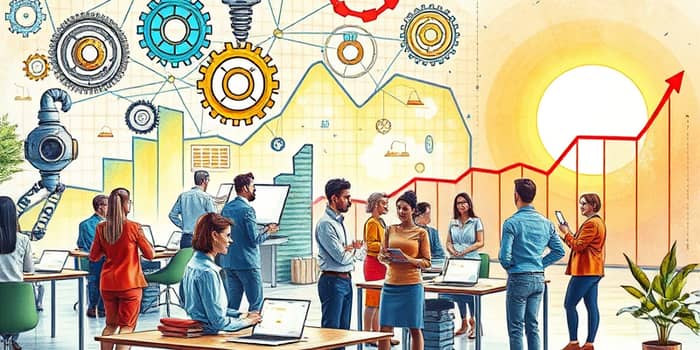
As the global economy shifts under the weight of technological innovation and demographic change, individuals and organizations alike must reconsider their approach to financial security. The emergence of artificial intelligence, tightening labor markets, and evolving skill demands are reshaping our professional landscape.
Effective financial planning in this context requires a clear grasp of trends, strategic investment in personal development, and an unwavering commitment to adaptability. This article outlines practical steps and inspiring insights to help you chart a course through uncertainty and build lasting resilience.
The accelerating deployment of artificial intelligence tools is transforming entry-level roles across finance, law, and administration. With 92% of companies planning to increase AI investments in the next three years and 75% of knowledge workers already using AI, the pressure to adapt is palpable.
Simultaneously, employers face a significant talent shortage. Seventy-four percent report difficulty finding qualified candidates, while 71% of employees worry that job security is slipping away. As the job market tightens, bargaining power shifts back to organizations, making it vital for individuals to differentiate themselves through unique strengths and ongoing learning.
Meanwhile, the decline of traditional white-collar roles is paralleled by growth in blue-collar opportunities. Infrastructure projects, renewable energy transitions, and skilled trades are booming, challenging assumptions about economic stability and opening new avenues for employment and investment.
In today’s landscape, skills have become the new currency. By 2030, 39% of employee skill sets will be transformed, emphasizing practical performance over formal qualifications. Organizations are increasingly investing in on-the-job bootcamps and personalized training programs, reducing the weight of traditional degrees.
Human-centric capabilities—dubbed “Power Skills”—now drive career advancement. Emotional intelligence, creativity, resilience, curiosity, and clear communication are more valued than ever as AI automates technical tasks.
However, an AI skills gap threatens to deepen inequality. Without proactive training and support, employees lacking digital fluency risk being left behind. Embracing continuous learning and digital fluency is no longer optional—it is essential.
The debate over remote versus in-office work continues to evolve. Hybrid models are seeing “hybrid creep,” with office days creeping upward—from 23% of hybrid workers in 2023 to 34% now spending four days on-site per week.
Flexibility is shifting from location to schedule. Companies are redesigning office spaces as collaboration hubs for brainstorming and social connection, while treating remote work as a premium benefit rather than a baseline expectation. This strategic approach positions remote work as a competitive advantage for attracting top talent worldwide.
Global talent mobility is on the rise. As boundaries blur, professionals can tap into opportunities across continents, increasing competition but also opening doors for those willing to demonstrate unique value.
CFOs are scrutinizing HR budgets closely, demanding measurable returns on training investments and AI implementations. Organizations are eliminating “nice to have” consultants and underutilized systems, while deploying AI agents to handle administrative tasks and free managers to focus on coaching and clarity.
Despite efficiency gains from automation, global employee engagement remains low—only 21% according to Gallup—revealing a productivity versus engagement paradox. Leaders who prioritize human sustainability, well-being, and trust-building will unlock the productivity gains that automation alone cannot deliver.
Rising healthcare costs and living expenses pressure both employers and employees, squeezing budgets and testing resilience. Organizations that balance disruptive innovation with stable support systems will build loyalty and maintain operational continuity.
Stability, transparency, and adaptability have become non-negotiable. Employers investing in fair AI adoption, transparent communication, and genuine retraining programs will cultivate a workforce equipped to navigate change.
In this evolving environment, financial planning must extend beyond basic budgeting and saving. It should integrate career development, skill-building, and risk management into a holistic plan.
Individuals should allocate resources toward continuous education platforms, emergency savings to weather job volatility, and diversified income streams such as freelance projects or side businesses. Meanwhile, companies must fund leadership development, flexible benefit programs, and inclusive AI training to mitigate inequities.
Gen Z and Millennials lead the charge for human-centric workplaces. They expect emotional intelligence and collaboration to weigh equally with technical expertise. Companies that honor these values will attract and retain the next generation of talent.
Ultimately, the future of work belongs to those who balance technology with humanity. Creativity, empathy, judgment, and connection remain our greatest competitive advantages. By embracing these qualities and integrating forward-thinking financial planning, individuals and organizations can navigate uncertainty, seize new opportunities, and build a sustainable, prosperous future.
References