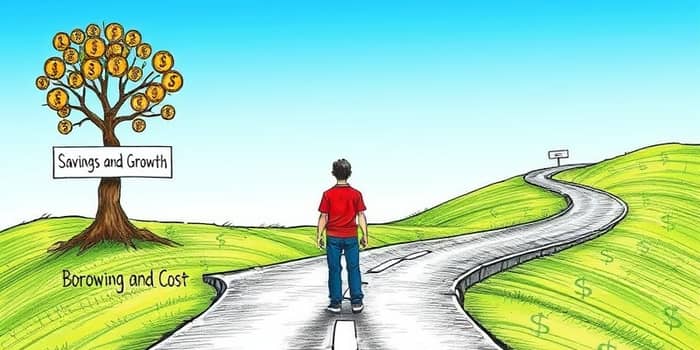
Every financial decision, from buying a home to funding education, hinges on understanding interest. It's the unseen force that shapes our economic lives, determining how much we pay or earn over time.
Grasping this concept empowers you to make smarter choices and avoid costly mistakes. This article will demystify interest, showing you its true impact.
Interest is not just a number on a loan document; it's a reflection of risk and reward in our financial system. By the end, you'll see borrowing in a new light.
At its core, interest is the price you pay to borrow money, or the earnings you receive for lending it. It's expressed as a percentage of the principal, which is the original amount involved.
The interest rate is this percentage applied annually or more frequently. Simple interest is calculated only on the principal, while compound interest includes accumulated interest, leading to exponential growth.
Understanding these basics is crucial. Here are key concepts to remember:
For example, with simple interest, a $100 loan at 5% for three years yields $15 in interest. Compound interest, however, accelerates growth or cost over time.
Interest exists for several economic reasons. Lenders charge it to compensate for the opportunity cost of not using the money elsewhere.
It also accounts for the risk of default, where borrowers might not repay. Inflation erodes purchasing power, so interest helps maintain value.
Higher risk leads to higher interest rates, making borrowing more expensive for those with poor credit. This system balances supply and demand in financial markets.
This rationale ensures that lending remains viable and encourages savings.
In everyday life, interest is quoted in various ways. Fixed rates remain constant, while variable rates change based on economic indicators.
Compounding frequency, such as monthly or daily, affects the effective rate. More frequent compounding means higher costs or earnings.
Loan term significantly influences total interest. Short-term loans, like auto loans, have lower total interest than long-term mortgages.
For instance, a variable-rate mortgage can lead to unpredictable payments, highlighting the importance of understanding terms.
The true cost of borrowing goes beyond the principal. It includes all interest and fees over the loan's life. Small rate changes can have massive impacts.
Consider an auto loan: a 1% increase in rate can add hundreds to the total. For mortgages, the difference can be tens of thousands of dollars.
Effective interest rate reveals the actual cost after compounding. APR, or Annual Percentage Rate, includes fees for a fuller picture.
Here is a comparison table to illustrate the true cost across different loans:
As shown, even slight rate hikes dramatically increase costs. Long-term loans amplify these effects, making careful planning essential.
This knowledge enables you to budget effectively and avoid debt traps.
Nominal rates are just the starting point. APR includes mandatory fees, offering a better measure of borrowing cost. Effective rates factor in compounding for accuracy.
For example, a loan with a 5% nominal rate and fees might have a 6% APR. This reveals hidden expenses that can surprise borrowers.
Always compare APR when evaluating loans. It standardizes costs across different offers, ensuring fair comparisons.
Tools like online calculators can help compute these rates, empowering you to make informed choices.
Interest is a powerful tool that can work for or against you. By mastering its principles, you can save money and build wealth over time.
Start by reviewing your current loans and investments. Look for opportunities to refinance at lower rates or increase savings with compound interest.
Financial literacy transforms lives, reducing stress and opening doors. Share this knowledge with others to foster economic well-being.
Remember, every percentage point matters. With diligence, you can navigate the true cost of borrowing and achieve financial freedom.
References